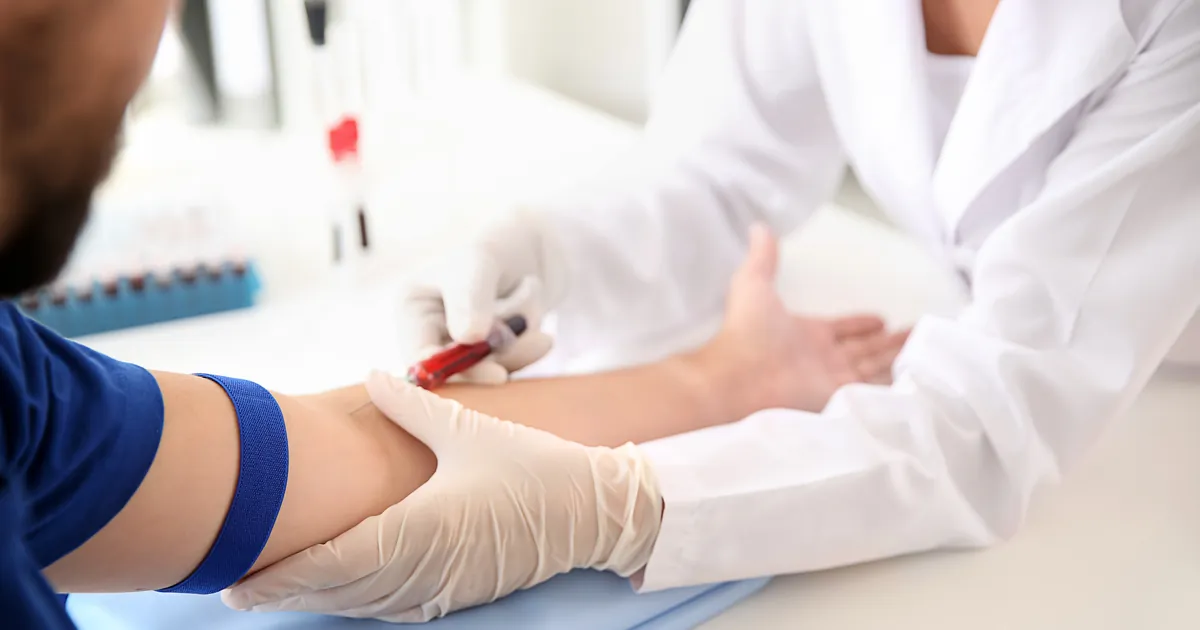
A phlebotomist draws blood for testing, transfusion, research and donation — and is responsible for the sample from the moment the needle goes in until it is logged and on its way to the lab. That second half is the part job descriptions skip, and it is where most of the shift goes.
There are about 143,540 phlebotomists working in the United States, earning a median of $45,230 a year (Bureau of Labor Statistics). Here is what they actually do.
The draw itself
The venipuncture is the visible part and the shortest. A typical draw runs a few minutes: confirm the order, identify the patient, choose the site, apply the tourniquet, draw into the correct tubes in the correct order, release, label at the bedside.
Two details in that list carry almost all the risk.
Patient identification. Two identifiers, checked against the order and the label, every single time. A correctly drawn sample attached to the wrong name is worse than no sample at all, because it produces a confident wrong answer about a real person.
Order of draw. Tubes contain different additives, and drawing them out of sequence lets additive carry over from one tube to the next and corrupt the result. The order is not a stylistic preference — it is a fixed sequence you learn in training and never improvise on.
Everything around the draw
Labelling at the bedside. Not at the cart, not at the station. Labels go on in the patient's presence, immediately, because every step of distance between draw and label is a chance to mix up two samples.
Handling and transport. Some tubes need inverting a specific number of times to mix with the additive. Some are light-sensitive. Some are time-critical and some need to reach the lab at a particular temperature. Getting a perfect draw and then mishandling the tube wastes the stick and the patient's time.
Documentation. Logging the draw, noting anything unusual, flagging a difficult stick for the next person. In most settings this is a lab information system, and being quick and accurate in it is a real part of the job.
Stocking and infection control. Trays, sharps containers, cleaning between patients. Unglamorous, constant, and the part that keeps everyone safe.
The part nobody trains you for first
A significant share of the work is that people are frightened. Some patients are needle-phobic. Some are children. Some are very ill, dehydrated, or have veins that have been drawn from too many times already.
The technical skill gets you the sample. The manner gets you the sample from someone who is crying, or shaking, or has already refused two other people. Experienced phlebotomists will tell you the second skill takes longer to build than the first, and it is the one that gets you asked back.
Where phlebotomists work
Hospitals. The widest variety and the most difficult draws — ICU, paediatrics, oncology, patients whose veins are genuinely hard. Usually 24-hour operations, which means nights and weekends exist, and so do shift differentials. This is where the upper end of the salary range tends to live.
Diagnostic labs and draw stations. Higher volume, more routine, more outpatient. You see many more people for much less time each.
Blood and plasma donor centres. Healthy donors, larger-volume collections, and a strong customer-service dimension — donors are volunteers who can simply not come back.
Physician offices and clinics. Smaller teams, more predictable hours, and often a broader role where you are also doing vitals, front desk or specimen processing.
Mobile and travel phlebotomy. Drawing in homes, workplaces or care facilities. More independence, more driving, and you are on your own when a draw is difficult.
What the job demands
- Steady hands and good technique — trainable, and the part school covers
- Attention to detail under repetition — the hundredth patient of the shift deserves the same two-identifier check as the first
- Physical stamina — a lot of standing and walking
- Calm — with frightened patients, and with your own nerves on a hard stick
- Stomach for it — blood, occasionally distressing situations
What it does not involve
You are not interpreting results. You are not diagnosing. You do not decide what tests are ordered. Phlebotomists collect and safeguard the sample — the analysis belongs to the laboratory scientists and the ordering clinician.
That boundary is exactly why the training is short. The scope is genuinely narrower than a nursing or lab-science role, which is what makes a 6%-growth healthcare career reachable in weeks rather than years.
Is it a good place to start?
For a lot of people it is the cheapest honest way to find out whether they want to work in healthcare at all — real patients, real clinical setting, without committing years first. We wrote about that trade-off in is phlebotomy a good career.
If it sounds like your kind of work, browse accredited programs by state — 1,252 of them, with real tuition and externship hours.